
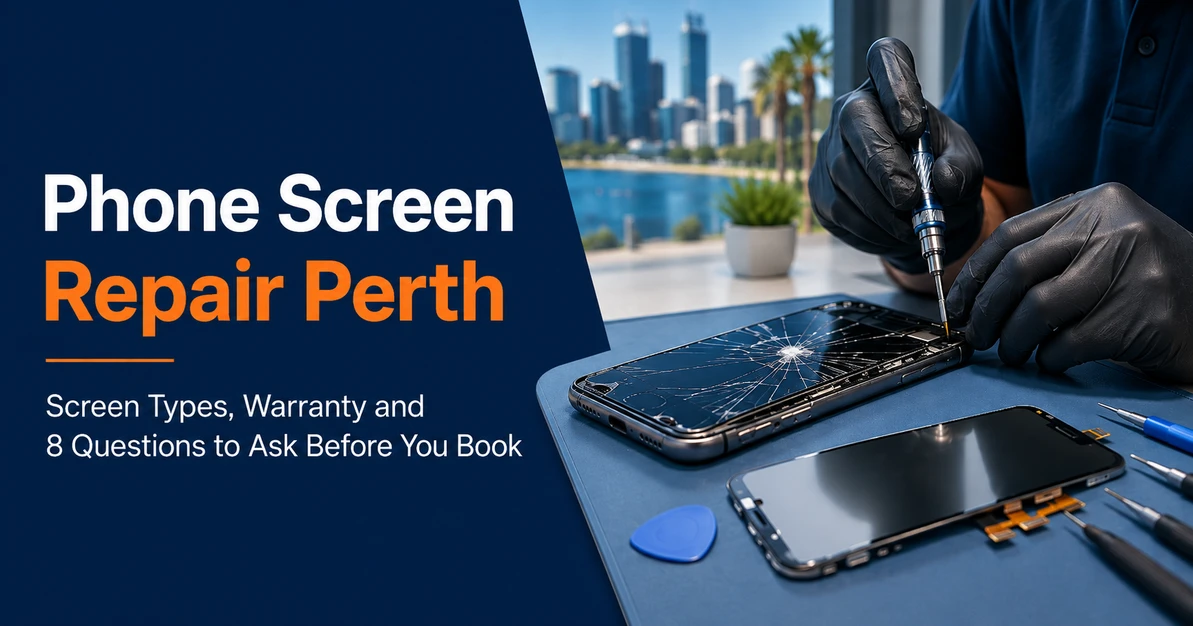
Phone Screen Repair Perth: Screen Types, Warranty and 8 Questions to Ask Before You Book
Quick answer: Most cracked phone screens can be repaired the same day. What you pay depends on three things: whether the damage stopped at the outer glass or reached the display underneath, whether your phone uses an OLED or an LCD panel, and whether the shop fits an original, service pack or aftermarket screen. Before you book, ask which part is being fitted, how long the warranty runs, and whether Face ID or the fingerprint sensor will still work afterwards.
A phone screen almost never breaks at a convenient moment. It slides off a car seat on Albany Highway, it goes face down on a tiled kitchen floor, or a toddler drops it once from waist height and that is that. The glass spiders, and suddenly you are trying to work out whether this is a thirty minute fix or the end of the phone.
The frustrating part is that quotes for the same model can differ noticeably between shops, and it is not always obvious why. Sometimes it is a different grade of part. Sometimes it is a different length of warranty. Sometimes one shop is quoting for glass only and the other is quoting for the full display assembly. This guide explains what is actually inside your screen, what changes the price, and exactly what to ask so you can compare two quotes properly instead of guessing.
If you would rather just get it looked at, you can walk into our phone repair shop in Perth on Albany Highway, or call the number further down this page for a quote on your model.
What is actually broken when a screen cracks
People say screen, but a modern phone screen is a stack of parts bonded into a single unit. From the outside in, you have the cover glass, then the touch layer known as the digitiser, then the display panel itself, and usually a set of flex cables and small sensors attached along the edges.
On phones made in the last decade these layers are laminated together with optical adhesive. That is why "just replacing the glass" is rarely a simple job. Separating the glass from the panel requires specialist equipment, and on many models the safer and more reliable option is to replace the whole assembly.
What you can see on the screen tells you a lot about how deep the damage goes.
| What you can see | What it usually means | Likely repair |
|---|---|---|
| Hairline cracks, display and touch both normal | Cover glass only | Glass or full assembly, depending on model |
| Black patch, ink blot or spreading bruise | Panel itself is damaged | Full display assembly |
| Green, pink or white vertical lines | Damaged panel or loose display connector | Inspection, then usually a new display |
| Areas that will not respond to touch | Digitiser fault | Full display assembly |
| Screen taps itself, or types on its own | Ghost touch, often after impact or moisture | Diagnostic first, display usually |
| Backlight gone, faint image under torchlight | Backlight circuit or panel failure | Board level check before quoting |
OLED and LCD: why the panel type changes everything
Two phones can look identical from the front and cost very different amounts to repair, because of what sits behind the glass.
LCD panels use a backlight shining through a liquid crystal layer. They are found on most budget and mid range Android phones and on older iPhones such as the iPhone 11 and XR. Replacement LCD assemblies are widely produced, so parts are generally easier to source.
OLED panels light each pixel individually, which is what gives you true blacks and thinner phones. Every recent flagship uses one, including the iPhone 12 series onward and essentially the whole Samsung Galaxy S range. OLED panels cost more to manufacture, are more fragile during removal, and on many Samsung models the under display fingerprint sensor is bonded into the panel, so it has to be recalibrated after fitting.
This is the single biggest reason a screen repair on a two year old flagship can cost several times what the same repair costs on a budget handset from the same year.
Original, service pack and aftermarket screens
This is where quotes diverge, and where you should ask the most questions. There are broadly three grades of replacement screen in the Australian market.
Original or service pack. Panels manufactured to the handset maker's specification. Colour accuracy, brightness, touch response and features like True Tone behave exactly as they did when the phone was new. This is the most expensive option and availability varies by model.
Quality aftermarket OLED. Third party OLED panels that get close to original on brightness and colour, at a lower price. Good ones are very hard to tell apart in normal use. Poor ones show colour shift at an angle, weaker peak brightness in sunlight, or slightly laggy touch.
Incell and standard LCD. Aftermarket LCD assemblies, typically used where the original was already an LCD. Cost effective and perfectly serviceable for everyday use.
None of these grades is automatically the wrong choice. A three year old phone you plan to keep for another twelve months does not necessarily need the most expensive panel available. What matters is that you are told which grade you are getting before the job starts, and that the price reflects it. A shop that will not tell you what part it is fitting is the problem, not the part itself.
What happens to Face ID, Touch ID and fingerprint sensors
This worries people more than anything else, so here is the plain version.
On iPhone, Face ID does not live in the screen. It sits in the sensor array at the top of the phone. A correctly performed screen replacement transfers that assembly across and Face ID keeps working. If Face ID stops after a repair, something was damaged or not reconnected during the job, and that is a workmanship issue you should raise immediately.
On older iPhone models with a physical home button, such as the iPhone 7, 8 and SE, Touch ID is paired to the original home button. That button must be carefully transferred to the new screen. It cannot be replaced with a new one without losing fingerprint unlock, because the pairing is done at the factory. Any shop working on these models should already know this.
On Samsung and other Android handsets with an under display fingerprint sensor, the sensor is often part of the display assembly. After fitting, it needs to be recalibrated so it reads correctly through the new panel. Ask whether that is included.
True Tone on iPhone also needs to be transferred from the original panel using programming equipment. Many shops do this as standard. Some do not, in which case automatic colour temperature stops working. It is worth a single question.
What actually drives the price of a screen repair
Rather than quote figures that go stale, here is what a technician is weighing up when they price your job.
- Model and panel type. OLED flagship, LCD mid ranger, or folding display. Folding screens sit in a category of their own.
- Part grade. Original, service pack or quality aftermarket, as above.
- Part availability. Very new releases and very old models both get harder to source.
- Frame condition. If the phone landed hard enough to bend the chassis, a new screen will not seat flat. That has to be addressed first.
- Additional damage. A drop that cracks the front often cracks the back glass or dents the camera surround as well.
- Labour complexity. Some models are designed to open easily. Others require adhesive removal, heat and considerable patience.
Because those variables move by model, the only useful number is a quote on your specific handset. Call with your exact model name and what you can see on the screen, and you can usually get an answer in under a minute.
8 questions to ask before you hand over your phone
Ask these of any repairer, including us. A good shop will answer all eight without hesitating.
- Which grade of screen are you fitting? Original, service pack, aftermarket OLED or LCD. Get the answer before the job, not on the invoice.
- How long is the warranty and what does it cover? There is a real difference between covering the part and covering the workmanship. Ask which.
- Will Face ID, Touch ID or my fingerprint sensor still work? And if the answer is no, why not.
- Will True Tone and auto brightness still function? Relevant on iPhone specifically.
- How long will it take, and can I wait for it? Many screen repairs are a same visit job. Some are not, and it is better to know before you arrange your day around it.
- What happens to my data? A screen replacement does not require wiping the phone. If someone tells you it does, ask why.
- What if you open it and find more damage? Ask whether they will stop and call you before doing extra work.
- Do I get an itemised invoice? You want the model, the part fitted and the warranty period in writing.
Warning signs worth walking away from
- No written quote and no invoice offered.
- Refusal to say what grade of part is being used.
- A quote well below every other shop with no explanation of why.
- Being told your data must be wiped for a screen swap.
- Being asked to hand over your passcode with no explanation of what it is for. Testing after a screen repair does sometimes require unlocking the device, but you are entitled to ask why and to be present.
- No physical address you can return to.
What to do before you bring the phone in
Five minutes of preparation makes the whole thing smoother.
- Back up. Screen repairs do not normally touch your data, but backing up before any repair is simply good practice.
- Remove your case and screen protector. Both are usually discarded during the job anyway.
- Take out your SIM and any memory card if you want to keep them with you.
- Photograph the phone front and back before you hand it over. Takes ten seconds and removes any later ambiguity about pre existing marks.
- Note any other faults. If the battery has been struggling or the charging port feels loose, mention it, because it is far cheaper to address while the phone is already open. Our guides on battery replacement warning signs and phones that will not charge cover what to look for.
Repair the screen, or replace the phone?
A reasonable rule of thumb: if the repair costs a meaningful fraction of what the phone is worth on the used market, and the phone already has other issues, replacing starts to make sense. If the handset is otherwise healthy and you are happy with it, repairing almost always works out better value than starting a new plan.
Two things people forget. First, a phone with a cracked screen is worth far less on trade in or resale than the same phone with a clean one, so the repair partly pays for itself if you plan to sell. Second, cracked glass keeps getting worse. Moisture and dust travel through the crack line, the damage spreads, and a repair that was straightforward can turn into a more involved one.
Is it safe to keep using a cracked phone?
For a day or two while you organise a repair, generally yes, with care. Longer than that and the risks build up. Loose glass fragments can cut fingers. The exposed edge lets in dust and moisture. Water resistance is already gone the moment the seal is broken. And if the panel is bruised or the touch layer is failing, the phone can start registering taps you did not make, which is more than an annoyance if it happens while you are typing a message or entering a passcode.
Stop using it immediately if you see the back or screen lifting away from the frame, which can indicate a swollen battery, or if the phone becomes unusually hot.
Warranty and your rights in Australia
Repairs carried out in Australia come with consumer guarantees under Australian Consumer Law, which sit alongside whatever warranty the repairer offers. In broad terms, services must be provided with due care and skill, and goods supplied as part of that service must be of acceptable quality. A shop warranty is in addition to those guarantees, not a replacement for them.
Every repair at Westcoast Repairs carries a three month parts and labour warranty. That covers a fault with the part we fitted or with our workmanship. It does not cover fresh physical damage or liquid damage occurring after the repair, which is normal across the industry. If something is not right after a repair, bring it straight back rather than waiting.
This is general information rather than legal advice. For your specific situation, the ACCC website is the authoritative source.
Where to get a phone screen repair in Perth
Westcoast Repairs is a walk in repair shop at 325 Albany Highway, Victoria Park, a few minutes from the Perth CBD and easy to reach from East Victoria Park, Burswood, Carlisle, Lathlain, South Perth and Bentley. No appointment is needed.
We handle iPhone screen repair, Samsung Galaxy screen replacement, Oppo repairs, Google Pixel repair, iPad screen repair, Apple Watch repair in Perth and MacBook repairs in Perth. Most screen and battery jobs are finished in 30 to 60 minutes.
Westcoast Repairs, Victoria Park
Address: 325 Albany Highway, Victoria Park WA 6100
Phone: 0405 672 390
Hours: Monday to Saturday 9:30am to 5:30pm, Sunday 11:00am to 5:00pm
Find us: mobile phone repair in Victoria Park on Google Maps
Not in Perth? See all our store locations, including phone repairs in Casuarina and phone repairs in Darwin.
Frequently asked questions
How long does a phone screen repair take in Perth?
Most iPhone and Samsung screen replacements are completed in 30 to 60 minutes while you wait, provided the part is in stock for your model. Less common models may need the part ordered in, which usually adds a day or two. Call ahead with your exact model and we can confirm before you travel.
Can a cracked screen be repaired without replacing the whole display?
Sometimes. If only the outer glass is cracked and the display and touch both work normally, glass only replacement is possible on certain models. On most modern phones the layers are laminated together, and replacing the complete display assembly is more reliable and often no more expensive once labour is counted. We will tell you which applies to your handset.
Will my data be deleted during a screen repair?
No. Replacing a screen does not require erasing the phone, and your photos, messages and apps stay where they are. We still recommend backing up before any repair as a general precaution. If a repairer tells you a screen replacement requires a factory reset, ask them to explain why.
Does replacing an iPhone screen break Face ID?
It should not. The Face ID sensors are located in the top sensor array, not in the display, and a correctly performed repair transfers that assembly to the new screen. If Face ID stops working after a screen replacement, it points to damage or a connection issue during the repair, and you should return the phone to the repairer straight away.
Is it safe to keep using a phone with a cracked screen?
For a short period, with care. Loose glass can cut your fingers, and the crack lets in dust and moisture which makes the damage spread. Water resistance is already compromised. Stop using the phone immediately if the screen or back panel is lifting from the frame, or if the device is getting unusually hot, as both can indicate battery swelling.
Do I need an appointment for screen repair in Victoria Park?
No appointment is required. You can walk into our Albany Highway store Monday to Saturday between 9:30am and 5:30pm, or Sunday between 11:00am and 5:00pm. Calling ahead on 0405 672 390 lets us confirm the part is in stock for your model before you make the trip.
Will a new screen affect my phone's water resistance?
Water resistance ratings apply to a phone in factory condition and are already lost once the original seal is broken by damage or by opening the device. We reseal with fresh adhesive during reassembly, which restores splash resistance, but no third party repair can restore a manufacturer's original rating. Treat any repaired phone as water resistant rather than waterproof.
Is a third party screen repair worth it, or should I just buy a new phone?
If the phone is otherwise working well and you are happy with it, repairing is usually the better value, particularly since a cracked screen sharply reduces trade in and resale value. Replacement makes more sense when the handset already has several faults, the battery is well past its useful life, or the model is old enough that parts are difficult to source. We are happy to give you an honest assessment either way.
Written by the technicians at Westcoast Repairs, a walk in phone repair shop on Albany Highway in Victoria Park, Perth, serving Western Australia and the Northern Territory.
Recent Posts
-
Is Your Phone Battery Draining Fast? Causes, Fixes and When to Replace It
Quick answer: Check your battery health percentage first, because it settles the question in about …16th Sep 2026 -
Phone Charging Port Not Working? Common Causes and Repair Options in Perth
Quick answer: A charging port that has stopped working usually comes down to one of four things: c …16th Sep 2026 -
Phone Water Damage Repair in Perth: What to Do Before Bringing Your Device to a Repair Shop
If it happened in the last few minutes: switch the phone off, do not plug it in, and do not press …16th Sep 2026